
Love of a Cat
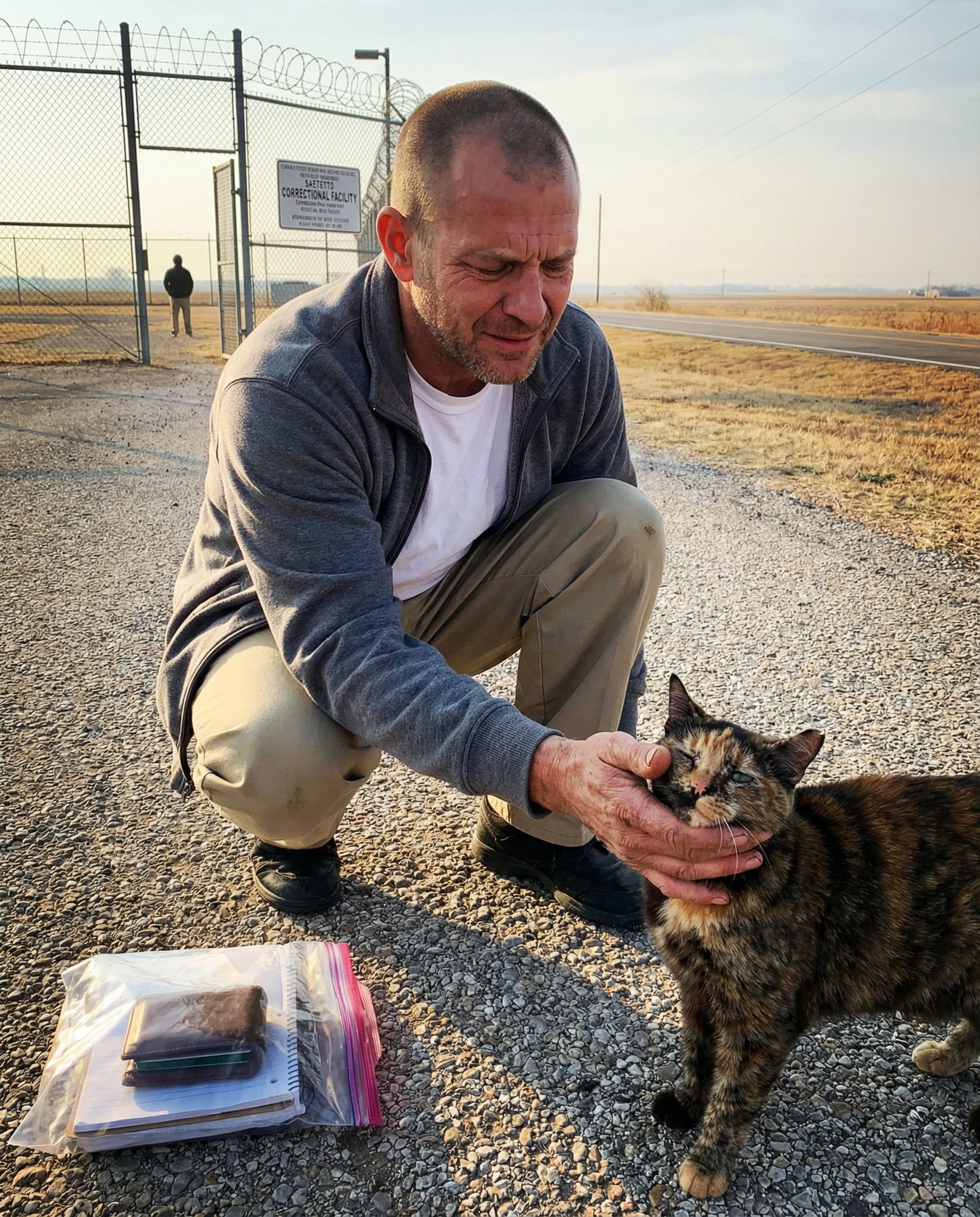
"The prison didn't allow pets. But every morning for seven years, a one-eyed cat walked through the yard gate at exactly 6 a.m. and sat outside the same cell window. When the man was finally released, he walked out the front gate. The cat was sitting there. She followed him home."
In a minimum-security correctional facility built on a flat stretch of dry farmland in the western reaches of rural Oklahoma, a man began serving a twelve-year sentence in the spring of 2014. He was twenty-nine years old. Armed robbery. A convenience store. Eighty-three dollars in the register. A weapon that turned out to be unloaded. A public defender who told him to take the plea. He took it.
He had no visitors. His mother had died the year before his arrest — an overdose in the apartment they shared. His father had left when he was four. He had one brother who had stopped answering letters after the first year. He had no wife. No children. No one on the outside counting days.
His cell was on the ground floor, east wing, third window from the end. The window was eighteen inches wide, reinforced glass, with a steel mesh screen on the exterior. It faced the yard, and beyond the yard, a chain-link perimeter fence, and beyond the fence, nothing. Flat brown Oklahoma dirt stretching to a horizon that never changed.
In September 2015, approximately eighteen months into his sentence, a cat appeared.
She was a small tortoiseshell. Thin. Dirty. Her left eye was missing — not injured, not infected, just gone. An empty socket, scarred closed, long healed over. Her right ear had a clean tip missing — the signature of a trap-neuter-release program. She had been caught, fixed, released, and forgotten. A community cat with no community.
She walked through the gap under the vehicle gate at the facility's service entrance at approximately 6 a.m. She crossed the empty yard — forty metres of open concrete that no stray animal had any reason to cross — and she sat down on the gravel strip outside the third window from the end of the east wing.
She sat there for twenty minutes. Then she left.
The next morning, she was back. Same time. Same window. Same position.
The man noticed her on the third day. He was lying on his bunk at dawn, staring at the ceiling the way he had stared at it for five hundred mornings, when a small shadow crossed the light from the window. He looked. A one-eyed cat was sitting on the other side of the mesh, looking in.
He pressed his hand against the glass. She pressed her face against the mesh.
He told no one.
Every morning for the next seven years, the cat walked through the gate at 6 a.m. and sat outside his window. Every morning. Summer heat that cracked 112°F on the concrete. Winter cold that froze the water in the yard drains. Rainstorms that turned the gravel strip to mud. She came.
He learned her patterns. She arrived at 6. She stayed until roughly 6:25. She would sit, clean herself, occasionally close her single eye in the early light. Then she would leave, back through the gate, into whatever world she disappeared to for the other twenty-three and a half hours.
He started saving portions of his meals. Small things. A piece of bread. A corner of meat from the cafeteria tray. He would wrap them in a napkin and push them through a gap at the bottom of the mesh screen where the caulking had crumbled. She would eat from the gravel directly below his window. He watched her eat every morning the way someone watches a candle — not because it does anything, but because it is the only light.
The guards knew. Of course they knew. A one-eyed cat sitting outside the same window every morning at the same time for years — that gets noticed. The facility protocol was clear. No animals. No feeding wildlife. No interaction through windows.
Nobody enforced it.
One corrections officer, a woman who worked the morning shift on the east wing for four of those seven years, said later to a colleague something that was never officially recorded:
"That cat was doing more for his rehabilitation than anything in our program. He had no infractions. No incidents. No fights. He kept his cell clean. He worked his kitchen assignment without complaint. He read forty-seven books in one year. The only time I ever saw emotion on his face was at 6 a.m. through that window. I wasn't going to take that from him."
The man kept a small notebook. Not a journal. A log. Every day for seven years, he recorded one line:
"She came."
Two thousand, five hundred and fifty-six entries. The same two words. Repeated on every page.
She came. She came. She came. She came.
On fourteen days over those seven years, the entry read differently:
"She didn't come."
He told a counselor during a mandatory session in his fifth year that those fourteen days were the worst days of his sentence. Worse than the arrest. Worse than the trial. Worse than the first night in a cell. Because on those days, the one living creature who had chosen to show up for him didn't show up, and he had to survive the possibility that she never would again.
She always came back.
On July 11, 2023, after serving nine years of his twelve-year sentence with time reduced for good behaviour, the man was released.
He walked out of the front gate at 7:30 a.m. carrying a clear plastic bag containing his personal effects — a wallet with no money in it, an expired ID, and a small notebook filled with two thousand five hundred and fifty-six entries of the same two words.
Sitting on the gravel outside the front gate, in the shade of the fence post, was a one-eyed tortoiseshell cat.
She was old now. Her fur was thinner. Her remaining eye was slightly clouded. She moved slower than she had seven years ago. But she was there. Not at his window. At the gate. As if she knew that today, the window wasn't where he would be.
He crouched down. She walked to him. She pressed her head against his hand — the same hand that had pressed against the glass two thousand five hundred and fifty-six times.
This time there was no glass.
He picked her up. She weighed almost nothing. He held her against his chest with one arm and walked down the service road away from the facility. He did not look back. She did not struggle. They walked together for the first time in seven years, moving in the same direction toward the same place.
A transitional housing program in a small town thirty miles from the facility accepted him that afternoon. Animals were allowed. He was given a room with a window that faced east.
She sleeps on that windowsill. Every morning she wakes at dawn, sits up, and watches the light come through the glass. But she doesn't leave anymore. She doesn't need to walk anywhere. She's already where she was going.
He works at a warehouse. He goes to meetings. He calls his brother, who finally answered, on Sundays. He is rebuilding a life from a clear plastic bag and a notebook and a cat who showed up one morning for no reason and never stopped.
He named her Finally.
When the transitional housing counselor asked him why, he said:
"Because I spent nine years behind glass. And she sat on the other side every single morning. And she waited. And now we're finally on the same side. That's her name. That's what she is."
The notebook is on his nightstand. He still writes one line every morning.
But it's different now.
"She's here."