
How Clem van Vliet acquired her Ritmüller grand piano
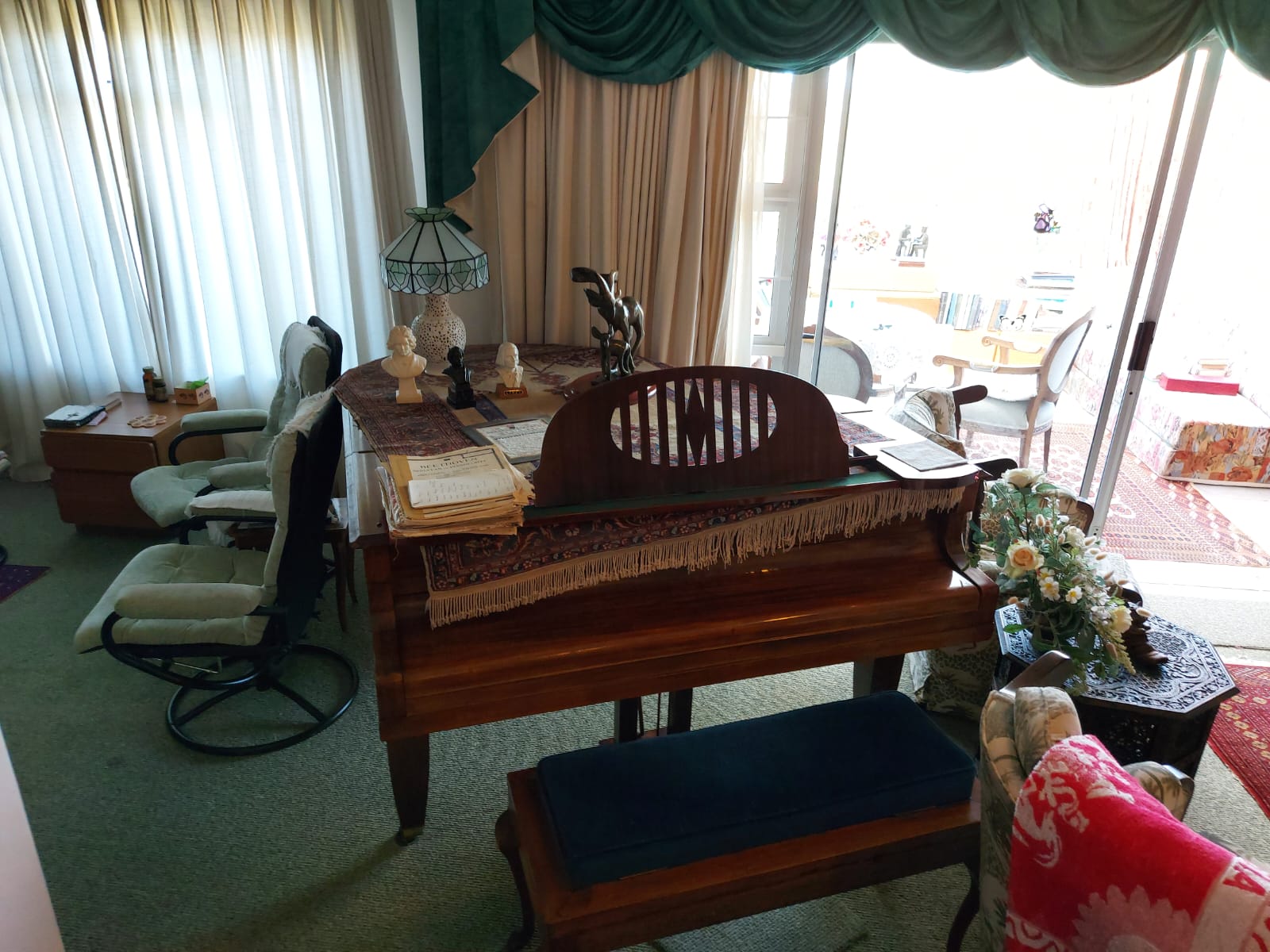


An oval shaped living room is attractive but not easy to furnish. For a start I did not know where to put my upright piano as it required an interior wall and there wasn’t one long and straight enough. Then I had a brainwave. I must get a grand piano. It would look really nice in the eastern oval where lots of windows gave good light and panoramic views. What a pleasure it would be to sit there and play the piano.
Due to sanctions, no new pianos had come into Rhodesia for years so I watched the newspapers, hoping someone would advertise a good used piano. I soon learned that most people regarded their tinny little baby grand pianos as full-sized Steinways, and asking prices accordingly. Eventually I spotted an advert that the old Palace Hotel was selling up, lock, stock and barrel and, among other things, their grand piano. I went to look at it. It was standing all by itself on a forlorn, empty stage at the back of the dining room at an awful angle, one castor being missing. It was a wreck. Original finish was black but it was chipped and stained with hundreds of rings made by wet glasses, strings rusted from beer, gin and whatever being spilled over them for years, keys yellowed, woodwork burned where cigarettes and cigars had been left to burn out.
I walked away disconsolately, but a little voice said “You’ve come this far, at least try it.” I turned back, climbed the few steps to the stage and went to the piano. The whole room was dark, curtains being closed. Just then a shaft of late afternoon sun pierced the gloom and shone over the old piano. I struck a few chords and it was as if something said “Take me out of here. Please rescue me.” It reminded me of the longing looks one gets from dogs at S.P.C.A. It was badly out of tune but the soundboard appeared to be intact.
I called on my piano tuner. I asked him to go and look at the piano and see if it could be restored. A few days later he reported that he thought his company could put it right. I asked what I should bid for it. “No more then $400.” I decided I would go to $500. (For the reader’s guidance – in those days you could buy a reasonable house for $7000. The Rhodesian dollar was the strongest currency on the sub-Saharan African continent.)
It came to the day of the sale and I went along early but found to my disappointment that there were thousands of items set out on trestle tables in the dining room – all the hotel’s crockery, cutlery, linen and so forth and I was informed that these were to go up for sale first. I sought out the auctioneer whom I knew and asked him to tell me more or less what time the piano would be arrived at.
“Not till this-afternoon at the earliest, maybe even tomorrow,” he said. “I’m interested so I’ll come back this-afternoon then,” I said.
I went back immediately after lunch with that feeling of eager anticipation I usually get before going to an auction sale. Now it so happened that a Catholic Mission was attending the sale and they bought up all the crockery, cutlery and linen in one big bid thus shortening the time of the sale no end. By the time I got back the dining room had been cleared and was empty. Only the piano was leaning drunkenly at an angle at the back of the stage.
Running outside where the sale was still in progress I made frantic signs at the auctioneer who stopped the sale and said,
“Are you bidding or waving good-bye?”
Cutting across his facetiousness, I called over the heads of the crowd,
“What’s happened to the piano?”
“Oh, it’s sold,” he said.
“But you knew I was interested. Couldn’t you have held it?” I asked despairingly.
“Oh, hell, I’m sorry Clem, but there’s another one upstairs. Thirty-five dollars I’ve got, any improvement on thirty-five….” And the sale continued.
There was an old upright upstairs, of no interest to me.
Dejectedly I made my way through the crowd and at the exit found one of the auctioneer’s assistants. On impulse I asked him who had bought the piano.
“Trevor D, the auctioneer from Gwelo.”
“How much did he pay?”
“$250.”
“Thanks.”
I waited till evening when I judged Trevor D. would be back at Gwelo. He wasn’t. The next morning I had better luck. He answered the telephone and I said,
“Mr. D. I believe you bought the grand piano at yesterday’s sale.?”
“That’s right,” he replied.
“If it’s not too impertinent of me, would you mind telling me whether you bought it for personal use or for re-sale?”
“For re-sale,” he said, confirming my surmise.
“How would you like to take $350 for it?” I asked.
“Done. Please stop the transport people who will be collecting it about now,” he said with enthusiasm.
“Right. Your cheque will be in the post today.”
I telephoned the auctioneer and explained. He was apologetic about his forgetfulness the previous day. He said.
“Tell you what, Clem. I’ll have the piano delivered anywhere you like free of charge to make up for yesterday’s boo-boo on my part. Am I forgiven?”
“Please deliver it to Smith & Hall’s depot,”
And so I acquired my Ritmuller medium grand. From the local depot it was transported to Salisbury where work was commenced. It was almost entirely rebuilt and the work took four months.
Here I must relate, sadly, that not long after this event the Bulawayo auctioneer concerned went to Angola on a visit and he was blown to bits by a land-mine.
When the piano was finally delivered, I was overjoyed.
It was brand-new, with a rich mahogany finish overall and completely rebuilt – new ivories, strings, balance weights and felts. . Reitmuller & Sons would have been proud. Still now, thirty-five years later, it looks like new. Many celebrities have played on it over the years and have been unstinting in their praise of the instrument. It has afforded me countless hours of pleasure and still I let my old bony fingers wander over the keys of an evening, playing a little Bach, Beethoven or Chopin, enjoying its perfect tone.