
Kindness
Amazing story
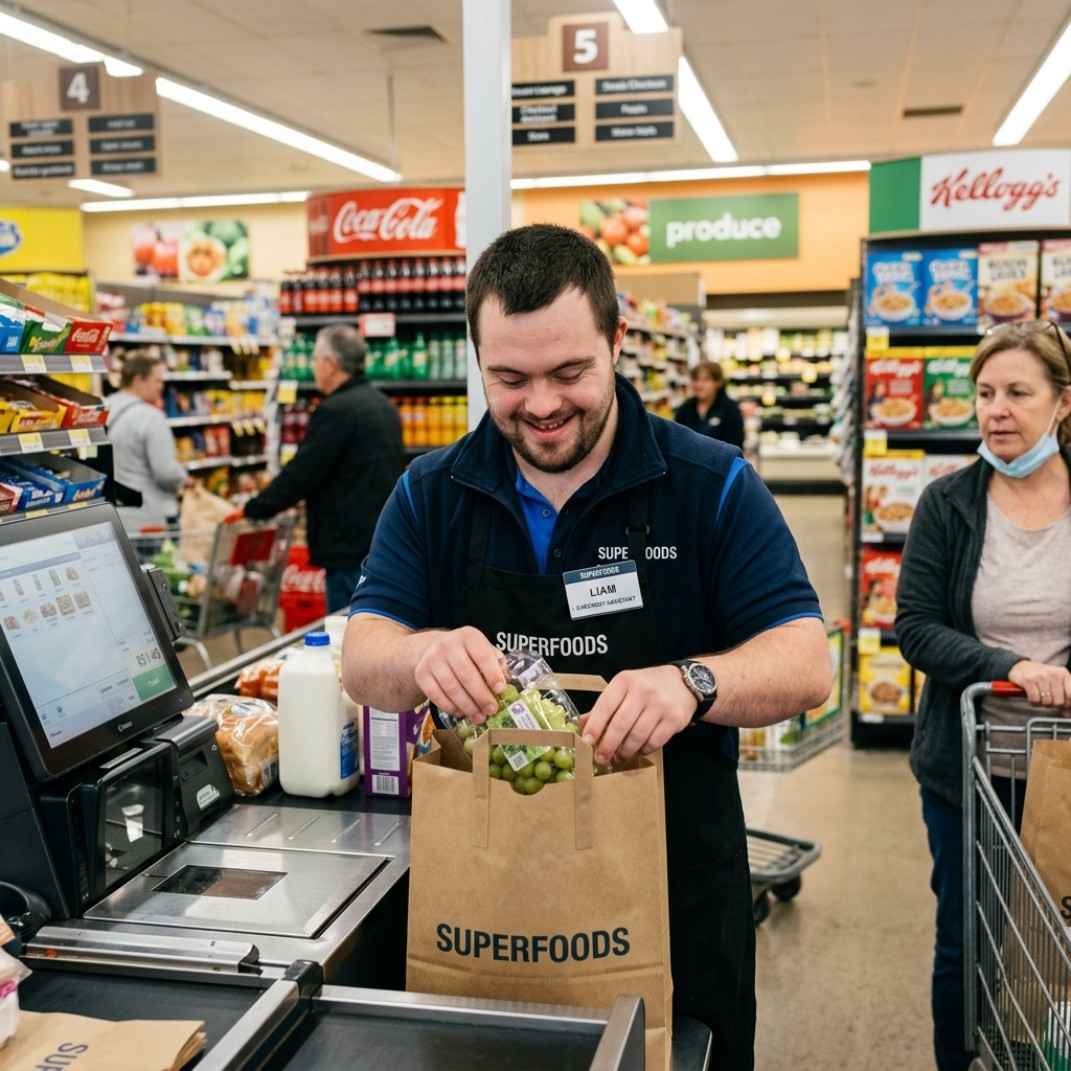
Tommy had Down syndrome and the best smile in the entire store.
He worked at Morrison's Grocery on Elm Street. Had been there for eleven years. Started when he was nineteen, right after his parents convinced the manager to give him a shot.
"Just a trial," his mom had said. "See how he does."
The manager—a guy named Ed who'd seen every kind of employee come and go—agreed to two weeks.
Tommy never left.
His job was simple. Bag groceries. Help people to their cars. Bring the carts back from the parking lot.
He wasn't fast. Took him longer than the other baggers to sort cans from bread, cold items from dry goods. But he was careful. Never crushed anything. Never put the eggs on the bottom.
And he talked to every single customer like they were the most important person he'd met all day.
"How are you today, ma'am?"
"That's a nice shirt, sir."
"Oh, you got the good ice cream. Smart choice."
Some people loved it. Some people ignored him. A few got impatient and asked for a different bagger.
Tommy never seemed to notice. Just kept smiling. Kept working.
There was this one woman—Mrs. Alvarez—who came in every Thursday afternoon. Always bought the same things. Bananas. Bread. Milk. A frozen dinner. Maybe some soup if it was on sale.
She was old. Eighty-something. Moved slow. Paid with cash she counted out carefully, her hands shaking.
Tommy always bagged her groceries. Always walked her to her car even though she only bought one or two bags. Always made sure she got in safely before heading back inside.
One Thursday, Mrs. Alvarez didn't come.
Tommy noticed.
He stood at the end of the register, watching the door, waiting for her. When his shift ended at four and she still hadn't shown up, he asked the cashier about it.
"Maybe she's sick," the cashier said.
Tommy frowned. He didn't like that idea.
The next Thursday, she didn't come either.
Tommy asked Ed if he knew anything.
"I don't know, Tommy. People stop coming in sometimes."
"But she always comes on Thursday."
"I know, buddy. But there's nothing we can do about it."
Tommy thought about that all weekend.
On Monday, he came to work early. Found Ed in the office.
"I want to check on Mrs. Alvarez," Tommy said.
Ed looked up from his paperwork. "What do you mean?"
"I want to make sure she's okay."
"Tommy, we don't know where she lives."
"Yes, we do. I walked her to her car. I remember the address on her checks."
Ed stared at him. "You remember her address from her checks?"
Tommy nodded. "1247 Maple Street. Apartment 3B."
Ed leaned back in his chair. Part of him wanted to say no. It wasn't professional. It wasn't safe. You can't just show up at a customer's house.
But another part of him—a part that had watched Tommy work for eleven years, had seen him treat every person with kindness even when they didn't deserve it—thought maybe this was different.
"Alright," Ed said. "But I'm coming with you."
They drove over after Tommy's shift. A small apartment building. Paint chipped. Steps cracked. Mailboxes overflowing.
They climbed to the third floor and knocked on 3B.
No answer.
Tommy knocked again. Louder.
Still nothing.
Ed was about to suggest they leave when they heard a faint voice from inside.
"Who is it?"
"Mrs. Alvarez?" Tommy called. "It's Tommy. From the grocery store."
A long pause. Then the sound of a lock turning.
The door opened a crack. Mrs. Alvarez peered out, face pale, eyes tired.
"Tommy?"
"Hi, Mrs. Alvarez. You didn't come to the store. I wanted to make sure you were okay."
Her eyes filled with tears. She opened the door wider.
The apartment was small. Neat but old. A single chair by the window. A TV on a wobbly stand. Not much else.
"I fell," she said quietly. "Two weeks ago. Hurt my hip. I can't drive anymore. Can't really walk much either."
Tommy looked at Ed. Then back at Mrs. Alvarez.
"Do you need groceries?" Tommy asked.
She nodded. "But I don't know how to get them."
"I can bring them," Tommy said. "Every Thursday. Just tell me what you need."
Mrs. Alvarez started crying then. Not sad crying. The kind of crying that happens when you've been alone for too long and someone reminds you that you're not invisible.
"You don't have to do that," she whispered.
"I want to."
Ed cleared his throat. "We'll work something out, ma'am. Don't worry about it."
And they did.
Every Thursday after that, Tommy shopped for Mrs. Alvarez. Used his employee discount. Paid for it out of his own paycheck. Delivered it to her apartment after his shift.
He didn't ask for gas money. Didn't ask for thanks. Just did it.
At first, Ed tried to stop him. "Tommy, you can't afford this. You don't make enough."
"She needs help," Tommy said. Simple as that.
Word got around the store. Other employees heard what Tommy was doing. A few of them started chipping in. Five bucks here. Ten bucks there. Enough to cover the groceries so Tommy didn't have to.
Then customers heard about it. And they started chipping in too.
Within a month, there was enough money to cover Mrs. Alvarez's groceries for the whole year.
Tommy didn't understand why people were giving him money. He wasn't doing anything special. He was just helping a friend.
But everyone else understood.
Because in a world where people walked past each other without looking up, where everyone was too busy or too tired or too stressed to notice when someone disappeared, Tommy had paid attention.
He'd noticed when one old woman stopped coming to the store. And instead of shrugging it off, instead of assuming someone else would handle it, he'd done something about it.
Mrs. Alvarez lived another three years. Every single Thursday, Tommy brought her groceries. Sat with her for a few minutes. Told her about his day. Listened to her stories about her late husband and her kids who'd moved away and never called.
She died peacefully in her sleep one night. Her neighbor found her the next morning.
Tommy cried when he heard. Cried harder than Ed had ever seen him cry.
At the funeral, there were maybe ten people. A couple of neighbors. A niece who flew in from Ohio. The priest.
And Tommy.
He sat in the front row, wearing the nicest shirt he owned, hands folded in his lap.
When it was over, the niece came up to him.
"You're Tommy," she said.
He nodded.
"She talked about you all the time. In every phone call. Every letter. She said you were the only person who checked on her. The only one who cared."
Tommy didn't know what to say.
The niece handed him an envelope. "She wanted you to have this."
Inside was a letter. Written in shaky handwriting.
Dear Tommy,
You have been the greatest blessing of my life these past few years. You treated me with kindness when I felt forgotten. You made me feel like I mattered. I don't have much to leave behind, but I want you to know that you made my last years worth living. Thank you for seeing me. Thank you for caring. You are a gift to this world.
Love, Mrs. Alvarez
Tommy folded the letter carefully. Put it in his pocket.
He still works at Morrison's Grocery. Still bags groceries. Still walks people to their cars.
And he still notices when someone stops coming in.
Because here's what eleven years at that store taught Tommy:
Everyone matters. Even the people who seem invisible. Even the ones who don't have family or friends or anyone checking on them.
Everyone deserves to be seen.
Tommy doesn't think of himself as special. He just thinks he's doing his job.
But his job isn't bagging groceries.
It's paying attention.
It's caring when no one else does.
It's showing up for people who've been forgotten.
And in a world that moves too fast and looks away too often, that's the most important job there is.